
During the month of September, crude steel production in Latin America totaled 4.8 million metric tons (Mt), representing a year-over-year increase of 5.1%. From January through September, production totaled 42.9 Mt, up 3.0% compared to the same period last year. Meanwhile, rolled steel production stood at 4.5 Mt, up 7.9% year-over-year, with a year-to-date total of 39.4 Mt, up 2.3% year-over-year.
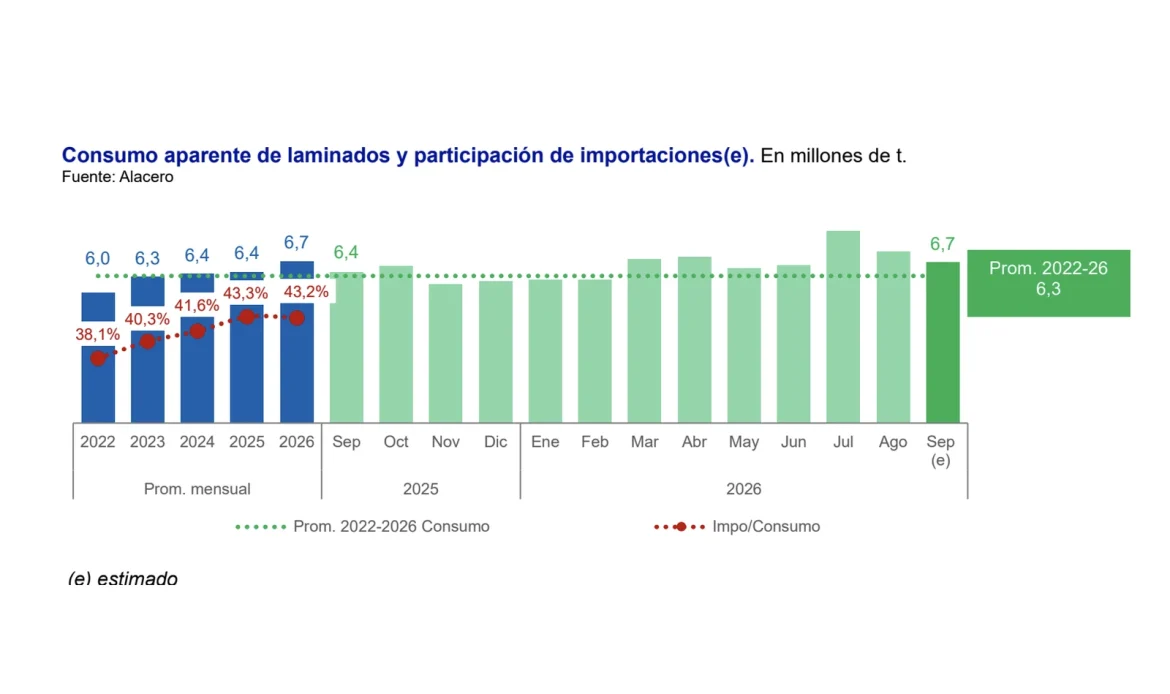
Apparent consumption of rolled products reached 6.7 Mt in September (up 3.5% year-over-year), marking a monthly average so far this year of 6.7 Mt, up from 6.4 Mt in 2025.
Imports reached 2.7 Mt during the month (0.1% year-over-year) and totaled 25.9 Mt year-to-date, with a 1.7% year-over-year increase. A country-by-country analysis reveals mixed trends: while Colombia and Peru posted import growth, Brazil, Mexico, and Argentina saw declines.
Exports, meanwhile, stood at 544,000 metric tons, down 0.4% compared to the same period last year and marking their third consecutive decline. For the first nine months of 2026, they totaled 5.4 Mt, a volume lower than that observed in 2025 (-0.9% year-over-year). Among the major exporters, Brazil leads in growth, while Mexico and Argentina continue to show a downward trend. As a result, the regional trade balance recorded a deficit of -2.2 Mt in September and accumulated a negative balance of -20.5 Mt between January and September, compared to the -20.0 Mt observed in the same period of 2025.
Steel-consuming sectors continue to show mixed performance. Year-to-date, the automotive and construction sectors remain the only ones experiencing growth. The construction sector has posted a 2.1% year-over-year increase and has recorded four consecutive months of growth, although it showed signs of slowing momentum in September. In contrast to these sectors, the machinery and household goods sectors remain in negative territory year-to-date.