
The study, prepared with the support of Alacero, links rising imports to the displacement of domestic steel production and the weakening of intraregional trade. Steel plants are operating at around 60% of their capacity, while trade among the six countries analyzed fell by 45% between 2019 and 2025.
The rise in low-cost global imports, driven by non-market policies and practices in exporting economies along the China-ASEAN corridor, is intensifying pressure on Latin America’s steel industry and weakening trade among countries in the region. This is one of the findings of the report Latin America’s Absorption of Global Steel Excess Capacity, published by the Organisation for Economic Co-operation and Development (OECD).
The study links this trend to global excess capacity, largely sustained by subsidies and other non-market policies and practices that distort competition. As domestic demand in China has stagnated, its producers have redirected part of their output to international markets.
Record Imports and China's Growing Presence
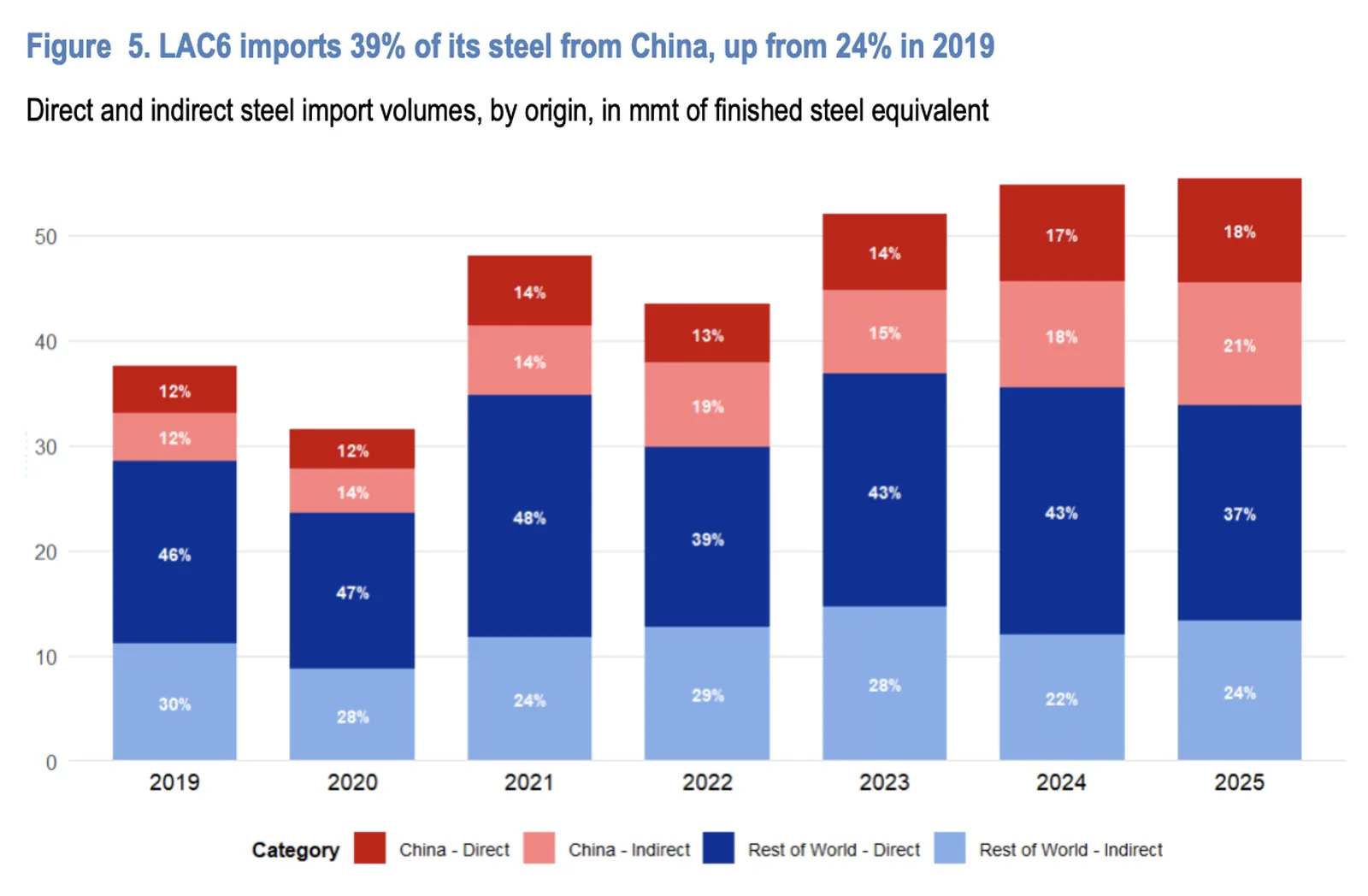
Between 2019 and 2025, Latin America’s total direct and indirect steel imports increased by 46.1%, from 49.3 million to 72 million metric tons of finished steel equivalent. In Argentina, Brazil, Chile, Colombia, Mexico, and Peru — the LAC6 group analyzed in detail — imports rose by 47%, from 37.6 million to 55.4 million metric tons.
China is the leading external supplier to these six countries. Its direct and indirect shipments increased by 137%, from 9.1 million to 21.6 million metric tons, while its share of LAC6 imports rose from 24% to 39%. Imports from countries belonging to the Association of Southeast Asian Nations (ASEAN) also increased, particularly in Mexico, Brazil, and Colombia.
The Impact Extends Across the Entire Value Chain
The pressure extends beyond steel imported as a steel product. Nearly 40% of LAC6’s total steel imports consist of steel embedded in machinery, vehicles, household appliances, and other manufactured goods.
Direct steel imports from China to LAC6 grew by 120% between 2019 and 2025, from 4.5 million to 9.9 million metric tons. Indirect imports increased even more, rising by 152%, from 4.6 million to 11.6 million metric tons. As a result, more than half of the steel imported from China by these countries in 2025 arrived embedded in other products, highlighting pressure that extends across the entire value chain.
The OECD also applies the TiVA-ICIO approach, based on inter-country input-output tables, to trace the origin of steel embedded in manufactured goods. In 2024, approximately 11% of the identified flows of steel originating in China and ASEAN and destined for LAC6 arrived through goods exported by third economies (such as North America, South Korea, Japan, and the European Union).
Lower Capacity Utilization and Weaker Regional Integration
Rising imports have contributed to keeping production capacity utilization at around 60%. At the same time, steel trade among LAC6 countries fell by 45% between 2019 and 2025, from 4.4 million to 2.4 million metric tons, while producers such as Brazil and Mexico lost market share in regional markets.
According to the OECD, these pressures, combined with high energy and logistics costs, increase the risks of deindustrialization and its economic and social consequences.
Against this backdrop, the report calls for stronger trade defense measures and international cooperation to address the root causes of excess capacity through initiatives such as the Global Forum on Steel Excess Capacity (GFSEC).
For Alacero, the findings reinforce the importance of jointly monitoring direct and indirect steel imports and coordinating responses that address the entire industrial value chain. The evidence provides a foundation for advancing concrete actions under the Milwaukee Framework and strengthening regional production and integration.