
In July, apparent consumption of rolled steel reached an all-time high of 7.1 million metric tons. At the same time, imports hit a monthly record of 3.2 Mt and now account for 41.4% of regional apparent consumption. As demand grows, Latin American production is showing signs of recovery, although year-to-date growth remains moderate.
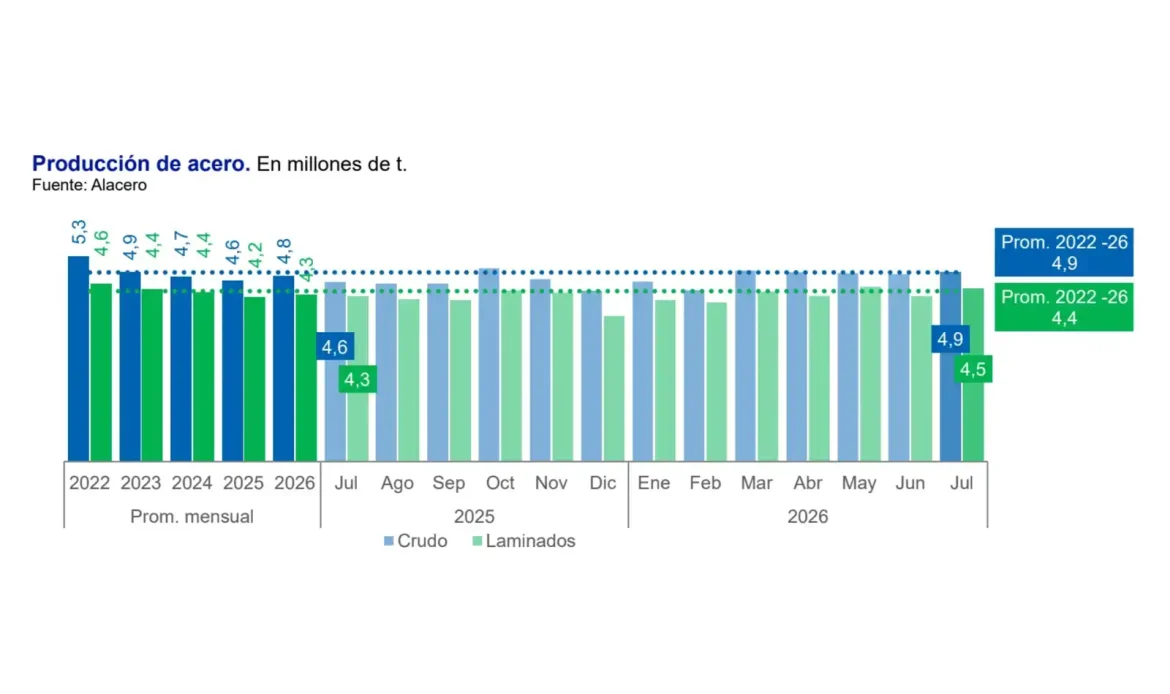
Crude steel production in Latin America reached 4.9 Mt in July, up 5.6% from the same period last year, with a year-to-date total of 33.4 Mt between January and July, marking a 2.6% year-over-year increase and the fifth consecutive month of growth. Meanwhile, rolled steel production totaled 4.5 Mt for the month, up 4.9% compared to July 2025. This surge brought the 2026 cumulative total to 30.1 Mt, a 0.6% year-over-year increase, reversing the decline that had characterized the cumulative total through June.
Apparent consumption of rolled steel reached 7.1 Mt in July, marking a 6.4% year-over-year increase—the highest monthly level since the series began in 2011. However, this growth was largely driven by imports, which rose 10.4% year-over-year and also reached a record high of 3.2 Mt for the month.
In the first seven months of 2026, imports totaled 18.8 Mt (+0.9%) and accounted for 41.4% of regional apparent consumption, compared to 41.0% in 2025 and 35.9% in 2022.
Exports totaled 576,000 metric tons during the month, down -0.6% year-over-year, and reached 3.9 Mt for the January-July period, nearly in line with the same period in 2025 (-0.1% year-over-year). As a result, the regional trade balance posted a deficit of -2.7 Mt in July and accumulated a negative balance of -14.9 Mt from January through July, widening from the -14.7 Mt recorded during the same period in 2025.
Among the main demand sectors, the automotive and construction sectors continue to post positive results, with cumulative growth of 3.3% and 1.9%, respectively. The machinery and household goods sectors remain in negative territory, although they have shown signs of recovery in recent months.