
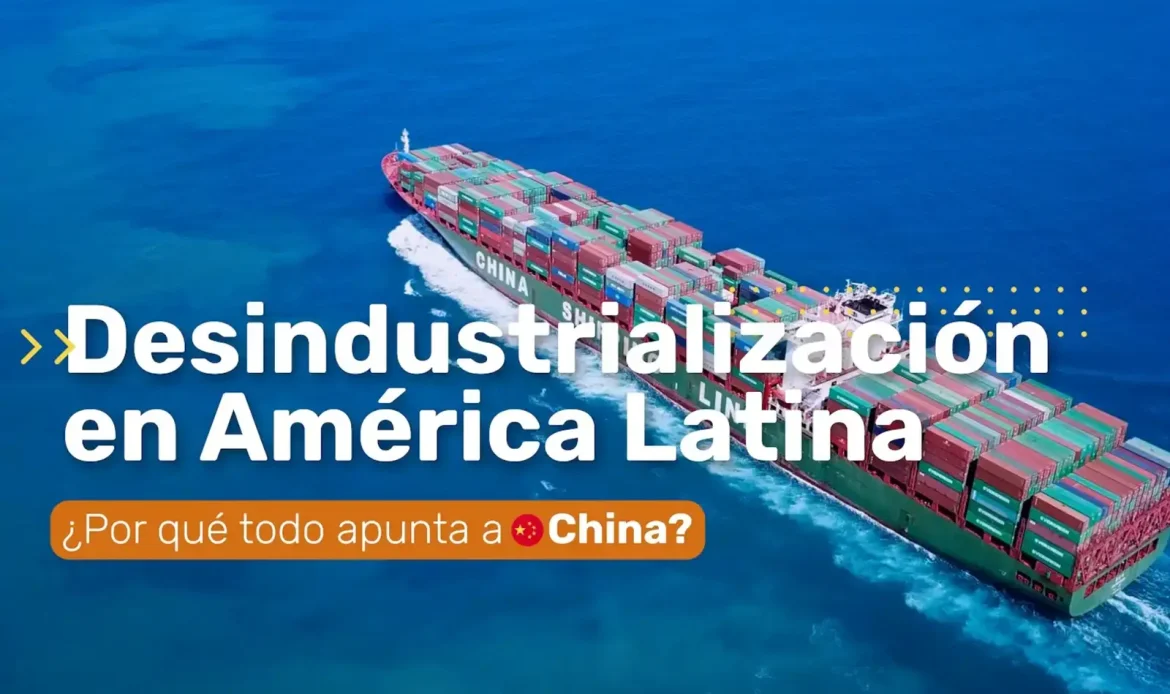
China’s overcapacity, subsidies, and export expansion are increasing pressure on industry, employment, and regional value chains.
Latin America is facing a process of deindustrialization with tangible consequences: factories closing, jobs disappearing, and production capacity weakening. To understand this pressure, Jorge Guajardo, former Mexican ambassador to China and a specialist in geopolitics and trade, suggests examining how the Chinese industrial model was built and how it functions.
Its origins are linked to decades of urbanization and infrastructure development. As Guajardo describes, China came to incorporate some 20 million people per year into its cities, generating enormous demand for steel, cement, glass, and other materials. To meet this demand, it developed an extensive industrial base.
When that engine loses momentum, the installed capacity remains and seeks buyers abroad. Steel illustrates the scale of this phenomenon: China accounts for about 52% of global crude steel production. In 2025, it produced 960.8 million metric tons (Mt) of crude steel; however, this exceeded its domestic demand by 131.4 Mt—a surplus roughly equivalent to the combined annual consumption of the United States, Mexico, and Canada. Between 2010 and 2024, China’s steel exports increased by 181% globally and by 233% to Latin America.
Competition does not take place on a level playing field. The Chinese industrial model is backed by government subsidies and support that affect production costs such as energy and financing. This allows products to be placed on international markets at artificially low prices, which are difficult for producers operating under normal market conditions to match.
Guajardo warns that, as the United States, Europe, and other markets tighten their trade measures, Chinese exports are seeking alternative destinations. Latin America is thus more exposed, against a backdrop of manufacturing’s declining share of the economy: manufacturing GDP in Latin America fell by 4 percentage points (p.p.) when comparing the 2010–2023 period with 1990–1999.
What is at stake goes beyond production. When an industry weakens, suppliers, expertise, and opportunities for entire communities can also be lost. For this reason, Guajardo proposes anticipating trade diversions, supplementing trade defense tools, and responding more quickly and in a more coordinated manner.
For Alacero, ensuring fair competitive conditions is essential to sustaining employment and preserving the capabilities that enable the region to produce, innovate, and develop.