
The first few months of 2026 paint a picture of contrasts for the steel industry in Latin America. While some indicators are beginning to show signs of recovery, challenges remain that continue to affect the region’s activity. The data comes from the LATAM Market Report, prepared by Alacero, which provides information on the evolution of the steel market in the region, an analysis of the regional macroeconomic context, and the performance of the main sectors that drive demand for steel.
The report compiles a series of key analyses, including the following:
The short-term macroeconomic outlook for Latin America is shaped by a combination of external and domestic factors that have once again come to the fore in recent weeks. After a brief respite, international volatility has returned to the regional scene.
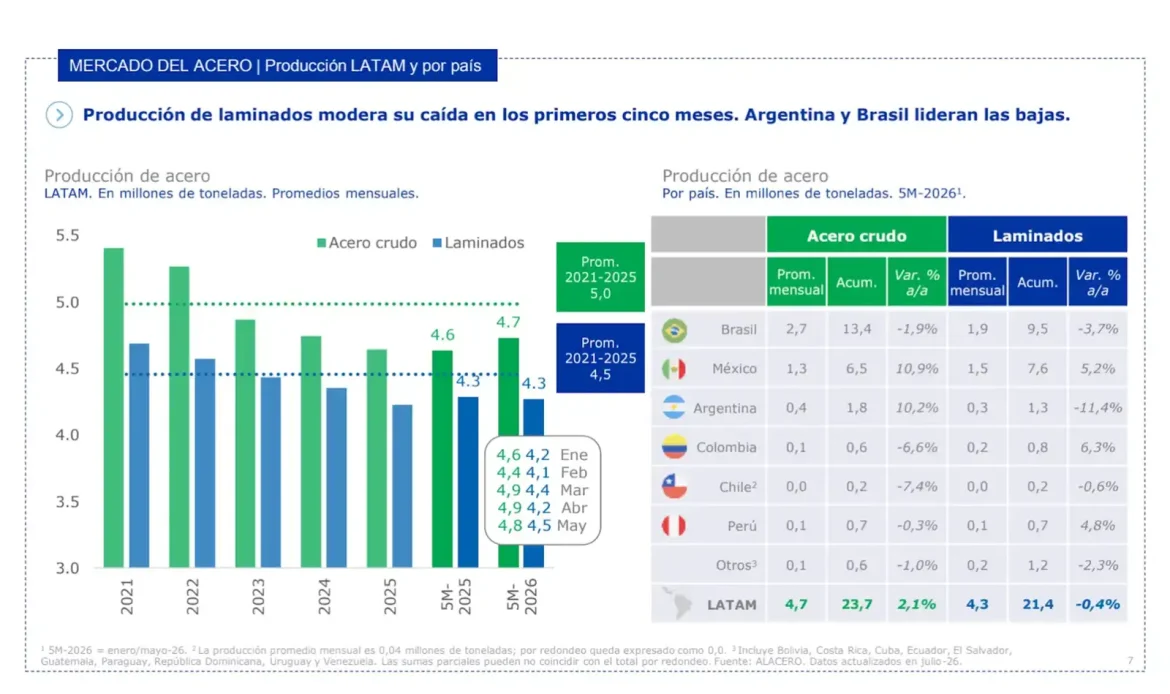
With regard to the steel market, the region showed mixed signals in the first five months of the year. The decline in rolled steel production moderated (-0.4% year-over-year), although it remains at its lowest level for the period since 2017—excluding the pandemic; crude steel, on the other hand, rose by +2.1% compared to the first five months of 2025, though it also remains well below its 2011–2025 historical average (5.2 Mt). Meanwhile, apparent consumption showed modest growth (+0.4% year-over-year in the first five months of 2026), following the contraction in the second half of 2025. On the external front, the region’s steel trade deficit remains high despite the decline in total imports (-3.0% year-over-year), after having grown by +6.5% in 2025. In this context, it is no coincidence that several countries in the region have moved forward with new trade defense measures against steel imports from Asia.
Performance across steel-consuming sectors was also mixed during the period. The automotive sector led growth (+3.5% year-over-year in 6M-2026), although it slowed sharply compared with the same period in 2025 (+6.2%). Construction, by contrast, is growing at a more moderate pace (+0.8%), driven by Peru (+11.4%)—fueled by the mining cycle—and Colombia (+5.3%). The most challenging outlook is facing the machinery (-2.7%) and household appliances (-8.7%) sectors, which are under pressure from the rise in Asian imports, with Argentina being the hardest-hit country in both sectors.
Access a summary version of the report; the full report is available exclusively to Alacero members via the extranet.