
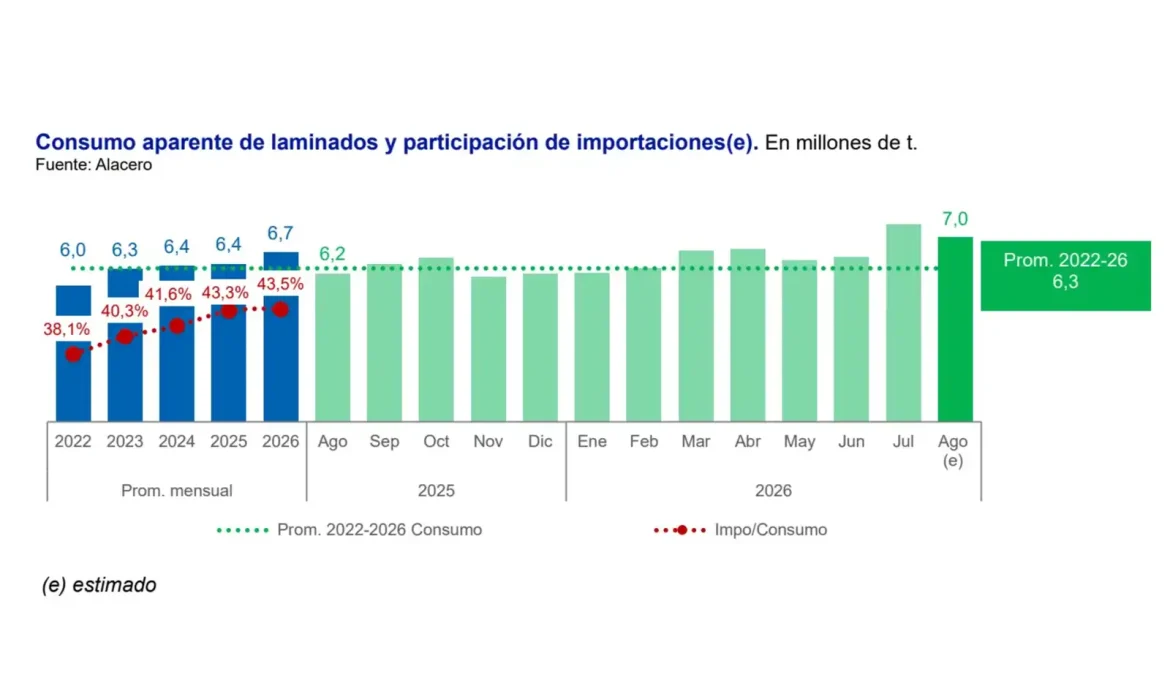
In August, crude steel production recorded its sixth consecutive month of year-over-year growth, while rolled steel production reached its highest monthly level of the year. Apparent consumption was the second-highest on record for the year. However, on the external front, exports declined and imports rose. Imports continue to account for a significant portion of regional apparent consumption, with a year-to-date total of 43.5% in 2026—the highest level on record.
Crude steel production totaled 4.7 Mt in August, marking a 3.7% year-over-year increase, with a year-to-date total of 38.2 Mt, up 3.0% year-over-year. Meanwhile, rolled steel production reached 4.6 Mt for the month, up 9.9% compared to the same month last year, and the year-to-date total jumped to 34.9 Mt, a 1.7% year-over-year increase. Apparent consumption of rolled products reached 7.0 Mt in August, marking a year-over-year increase of 12.9%. With this figure, the monthly average for 2026 stood at 6.7 Mt, up from 6.4 Mt in 2025.
Imports totaled 2.9 Mt in August, marking a 12.3% year-over-year increase, with a cumulative increase of 2.3% from January through August. A breakdown of the cumulative total by country reveals two opposing trends: in economies such as Chile and Peru, imports are growing, while in the three largest economies—Brazil, Mexico, and Argentina—they are declining, although the decline moderated in all three cases in August.
Exports fell by -4.9% year-over-year to 522,000 metric tons—their lowest monthly level of the year—and totaled 4.8 Mt in the first eight months of 2026, slightly below the same period in 2025, at -1.1%. Among the major exporters, Brazil leads in growth, while Mexico and Argentina continue to decline. Consequently, the regional trade balance recorded a deficit of -2.4 Mt in August and closed the January–August period with a negative balance of -18.4 Mt, compared to -17.9 Mt for the same period in the previous year.
Steel-consuming sectors continue to show mixed performance. Year-to-date, the automotive and construction sectors remain the only ones showing growth: the former grew 2.8% in the first nine months of the year, and the latter grew 1.2% between January and August. At the other end of the spectrum, the machinery and household goods sectors remain in negative territory.