
By 2026, production is projected to recover and consumption to grow, in a scenario marked by an economic slowdown, low investment, and rising imports, especially from China.
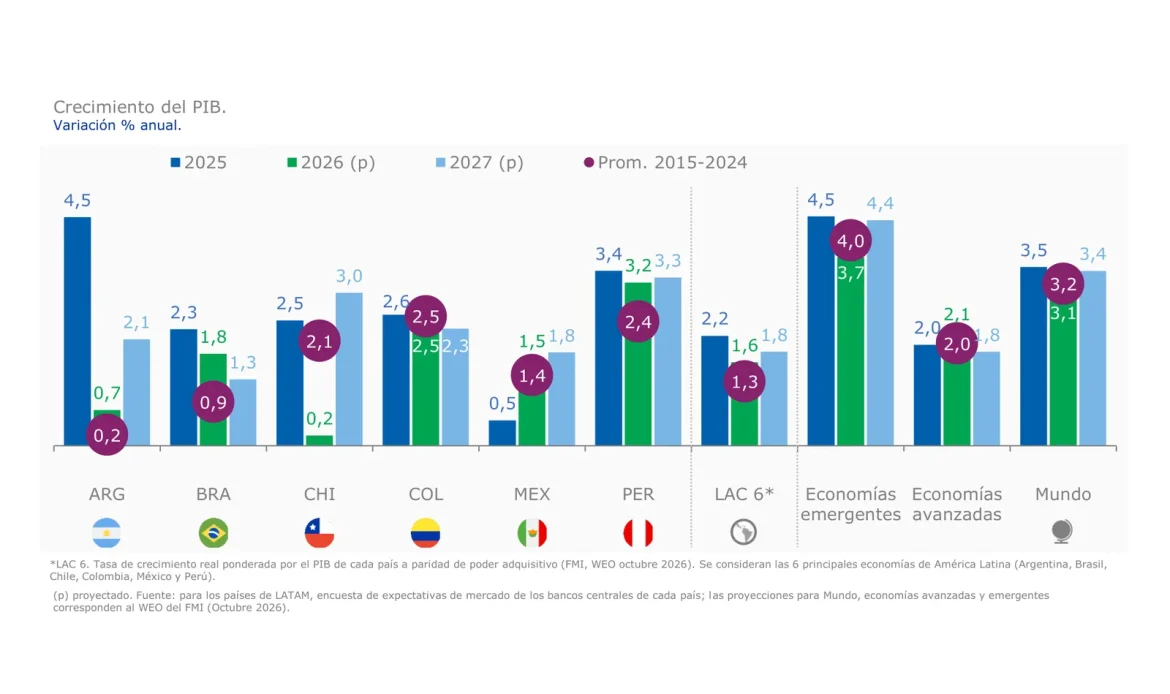
The Latin American economy continues to face a scenario of low growth and uncertainty. In 2026, GDP in the region’s six major economies is projected to grow by 1.6%, down from the 2.2% recorded in 2025 and below the estimated global average of 3.1%. Compounding this situation are structural challenges such as weak investment and the decline in the manufacturing sector’s share of the region’s economy, down 3.9 percentage points between 2010 and 2025.
Meanwhile, regional crude steel production is estimated to reach 57.7 million metric tons (Mt), a 3.6% year-over-year increase, driven mainly by the recovery in Mexico (+12.5%) and Argentina (+7.7%). Rolled steel production is also expected to improve by 3.4%, reaching 52.9 Mt, although it would still remain below 2024 levels.
As for apparent consumption of rolled steel, growth of 1.7% is projected, reaching 78.4 Mt. However, a large portion of this demand continues to be met by imported products. Driven by trade diversion to Latin America and record-high exports, China is expected to increase its share of regional rolled steel imports, reaching a new all-time high.
Regional imports of rolled steel from China are estimated to grow by 3.7% in 2026, reaching 15.7 Mt and accounting for approximately 46% of total imports. In contrast, intraregional trade remains below 10%, highlighting the need to strengthen productive integration and value chains in Latin America.
This scenario is unfolding against a backdrop of global overcapacity, which is projected to reach 640 Mt in 2025 and could rise to 745 Mt by 2028. Meanwhile, China accounts for more than half of this excess capacity and continues to expand its presence in international markets through industrial subsidies and unfair trade practices. According to estimates, exports of rolled steel and semi-finished products are projected to reach a new high of 133.8 Mt in 2026, while exports of indirect steel products are expected to reach 150 Mt.
Latin America also faces the challenge of boosting investment and strengthening its industrial development. While the region has been investing around 20% of its GDP since the 1990s, the gap with emerging markets widened from 4.6 percentage points (1990–99) to 12.2 percentage points (2020–25). This situation limits growth in strategic sectors such as construction, machinery, and infrastructure—which are fundamental to steel demand and the creation of industrial jobs.
Strengthening regional production, boosting investment, and advancing an agenda of trade defense and productive integration will be essential to transforming growth in demand into more industry, jobs, and development for Latin America.