
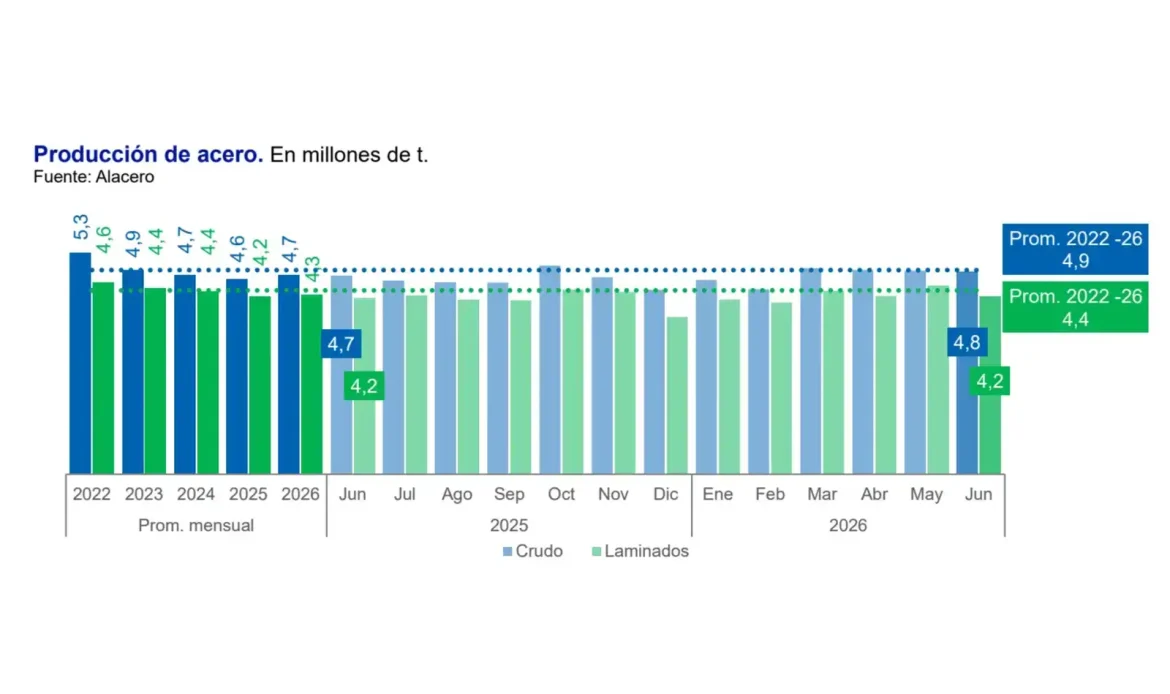
Crude steel production grew by 2.1% in the first half of 2026, while rolled steel production remained virtually stable (-0.3%). Apparent consumption rose by 1.0%, but imports continue to account for more than 40% of the regional market. Against this backdrop, various Latin American countries are moving forward with trade defense measures and initiatives to promote local production.
The figures show an improvement in activity in June, although the overall picture for the first half of the year remains mixed.
Crude steel production reached 4.8 million metric tons (Mt) in June, up 2.1% from the same period last year and marking its fourth consecutive month of growth. For the first half of the year, production totaled 28.5 Mt, also 2.1% higher than the same period in 2025.
Rolled steel production also improved in June, growing 0.6% compared to the same month of the previous year, with a volume of 4.2 Mt. However, for the first half of the year, it totaled 25.6 Mt, still 0.3% below the same period of the previous year. By segment, long-product production remained stable, while flat-product production declined by 0.9% and seamless-tube production grew by 6.8%.
Apparent consumption of rolled steel reached 6.4 Mt in June, in line with the monthly average for the first half of the year. Between January and June, it totaled 38.2 Mt, a 1.0% increase compared to the same period in 2025.
Imports continue to account for more than 40% of consumption
On the external front, imports reached 2.6 Mt in June, marking a 4.0% year-over-year increase. For the first half of the year, they totaled 15.6 Mt, down 1.0% from the same period in 2025. Despite this slight decline, imports continued to account for 40.7% of apparent regional consumption, maintaining a high share of the Latin American steel market.
Performance varied across the major markets. Brazil (-21.8%), Argentina (-13.6%), Chile (-12.8%), and Mexico (-9.2%) saw their imports decline year-to-date, while Colombia (+17.9%) and Peru (+25.1%) recorded increases.
Exports, meanwhile, reached 3.3 Mt during the first half of the year, down 0.4% year-over-year. Brazil posted growth of 19.3%, as did Chile (+11.4%) and Peru (+4.0%), in contrast to the declines in Argentina (-18.3%), Colombia (-28.6%), and Mexico (-22.3%).
As a result, the regional trade balance posted a deficit of 12.3 Mt between January and June, virtually unchanged from the 12.4 Mt recorded in the first half of 2025. In June alone, the deficit stood at 2.0 Mt.
Demand-side sectors continue to show mixed performance
The performance of the main steel-consuming sectors also varied during the period. Construction posted cumulative growth of 0.8% during the first half of the year and showed a significant improvement in June (+4.9% year-over-year), with positive contributions from Colombia, Mexico, and Argentina.
In contrast, industrial production declined by 0.5% for the first half of the year, while machinery (-5.6%) and household use (-7.8%) remained in negative territory. Household use, however, broke a seven-month streak of year-over-year declines in June, posting growth of 2.5%.
The automotive sector remains the main positive outlier among demand-driven sectors, with cumulative growth of 3.2% in the first seven months of 2026, driven primarily by Brazil (+8.7%).
Latin America Strengthens Its Trade Defense Measures
The high volume of imports and the pressure facing regional manufacturing occur against a backdrop of growing competition from products originating in Asia. As noted in the LATAM Market Report, the rise in Asian imports has been particularly affecting manufacturing sectors such as machinery and household appliances.