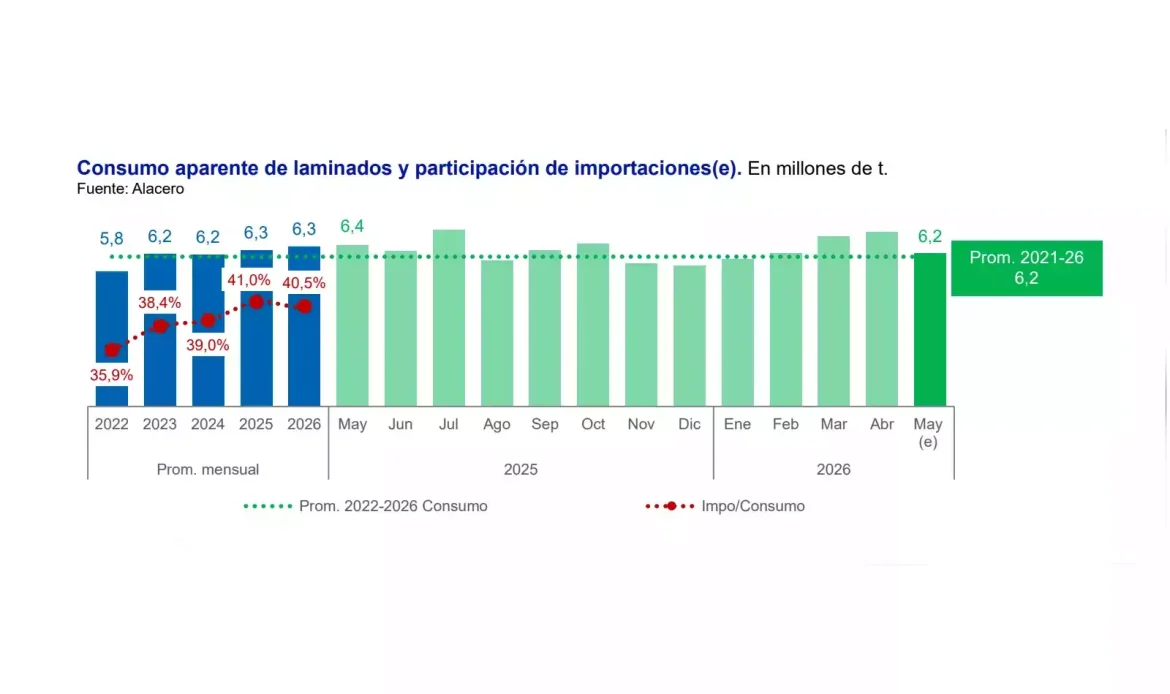
The Latin American steel industry maintained relatively stable levels of activity in May 2026. Production of crude steel and rolled products increased compared to the same month of the previous year, while apparent consumption remained virtually unchanged year-to-date. Although imports declined, they continue to account for 40.5% of regional consumption, maintaining a high share of the Latin American market.
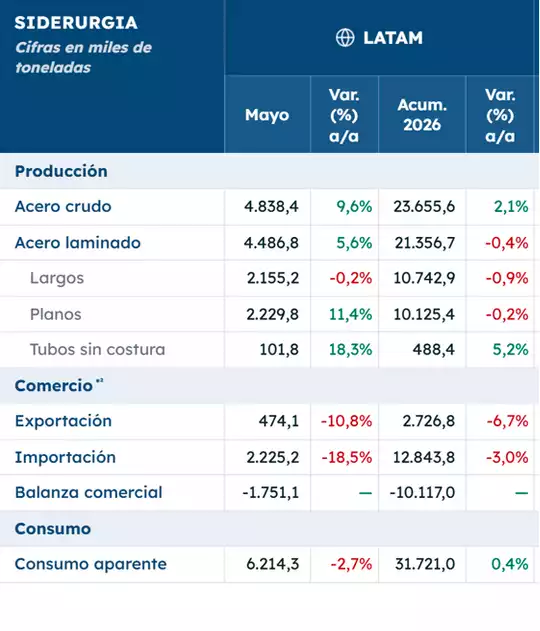
Crude steel production reached 4.8 million metric tons in May, a 9.6% year-over-year increase. In the first five months of 2026, production totaled 23.7 million metric tons, 2.1% more than in the same period the previous year.
Meanwhile, rolled steel production totaled 4.5 million metric tons in May, a 5.6% year-over-year increase. However, the cumulative total from January through May stood at 21.4 million metric tons, a slight 0.4% decline compared to 2025.
Apparent consumption of rolled steel reached 6.2 million metric tons in May, down 2.7% from a year ago. Cumulative consumption for the first five months totaled 31.7 million metric tons, virtually the same level recorded in the same period of 2025 (+0.4%).
Imports totaled 2.2 million metric tons in May, an 18.5% year-over-year decrease. From January through May, they reached 12.8 million metric tons, down 3.0%. Despite this decline, imported products accounted for 40.5% of regional apparent consumption.
Performance varied widely among the major markets. Brazil, Chile, Argentina, and Mexico saw a year-to-date decline in imports, while Colombia and Peru recorded increases of more than 20%.
Exports reached 474,000 metric tons in May and totaled 2.7 million metric tons in the first five months, a 6.7% year-over-year decline. Brazil was the only major producing country to increase its exports, in contrast to the declines recorded in Argentina, Colombia, Mexico, and Peru.
As a result, the regional trade balance showed a deficit of 1.8 million metric tons in May and accumulated a negative balance of 10.1 million metric tons between January and May 2026.
Among the sectors that use steel, performance remained largely negative. The exceptions were the automotive sector, which grew 3.5% in the first half of the year, driven by Brazil, and the construction sector, which posted a cumulative increase of 0.8%, buoyed by strong performance in Colombia and Peru and some positive signs in Argentina.
Alacero members can access the complete information in the new LATAM Data Monitor, available through the Association’s Extranet. The platform centralizes historical and comparative data to facilitate monitoring and analysis of the regional industry.