The study “Trade Policy Instruments for the Steel Sector,” prepared by Quipu Advisors for Alacero, presents an analysis of the main tools applied across the entire steel value chain between 2008 and 2026.
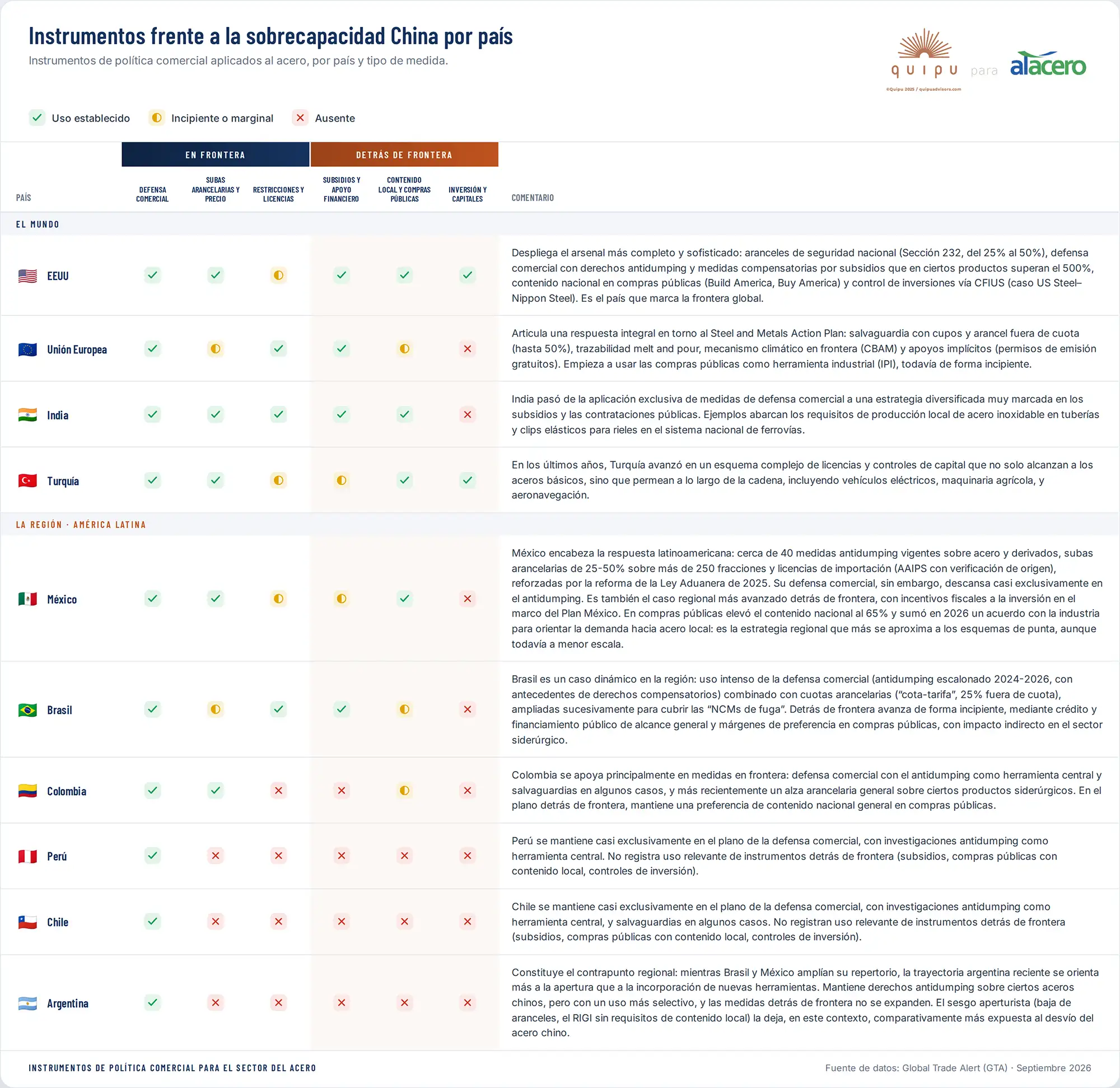
The survey examines 18,475 trade policy measures, of which 4,934 were applied to basic steels and 3,345 affected China. The study distinguishes between two major groups of instruments: “at-the-border” measures—such as antidumping duties, safeguards, tariffs, and quantitative restrictions—and “behind-the-border” measures—including financial support for producers, government procurement, local content requirements, investment rules, and capital controls.
The countries that have fared best in this new landscape—such as the United States and Europe—have combined “at the border” and “behind the border” measures into coordinated packages. Furthermore, protectionism has not been limited to basic steel products; rather, these strategies are increasingly being deployed across the entire value chain.
The study also shows that Latin America continues to lag behind the rest of the world and exhibits significant internal disparities. Mexico has developed the broadest and most advanced mix of measures; Brazil combines active trade defense with broad-based public loans and financing for its industry; while Argentina has adopted a more open-market approach in recent years, with relatively less use of trade and industrial policy tools.
Traditional trade defense measures have lost relative importance. Over the past ten years, “at the border” measures applied globally to basic steel imported from China came to account for 31% of the total (vs. 49% between 2009 and 2014), while “behind-the-border” measures increased to 69% (vs. 51%).
Globally, developed countries account for 66% of the measures implemented over the past five years. Latin America accounts for just 7%—or 3.28% if Brazil is excluded. This dynamic is detrimental to the region, which is slow to react and lacks a rapid response.
“Industrial policy has once again taken center stage in the global debate as a tool increasingly used and accepted by major economies. It is important for Latin American countries to respond more nimbly and in a coordinated manner to avoid suffering the predatory consequences of Chinese trade on our local industrial supply chains,” explained Ezequiel Tavernelli, Executive Director of Alacero. “At the same time, there is a strategic opportunity to seek an alliance with Western countries to reorient supply chains by leveraging Latin America’s structural advantages,” he concluded.